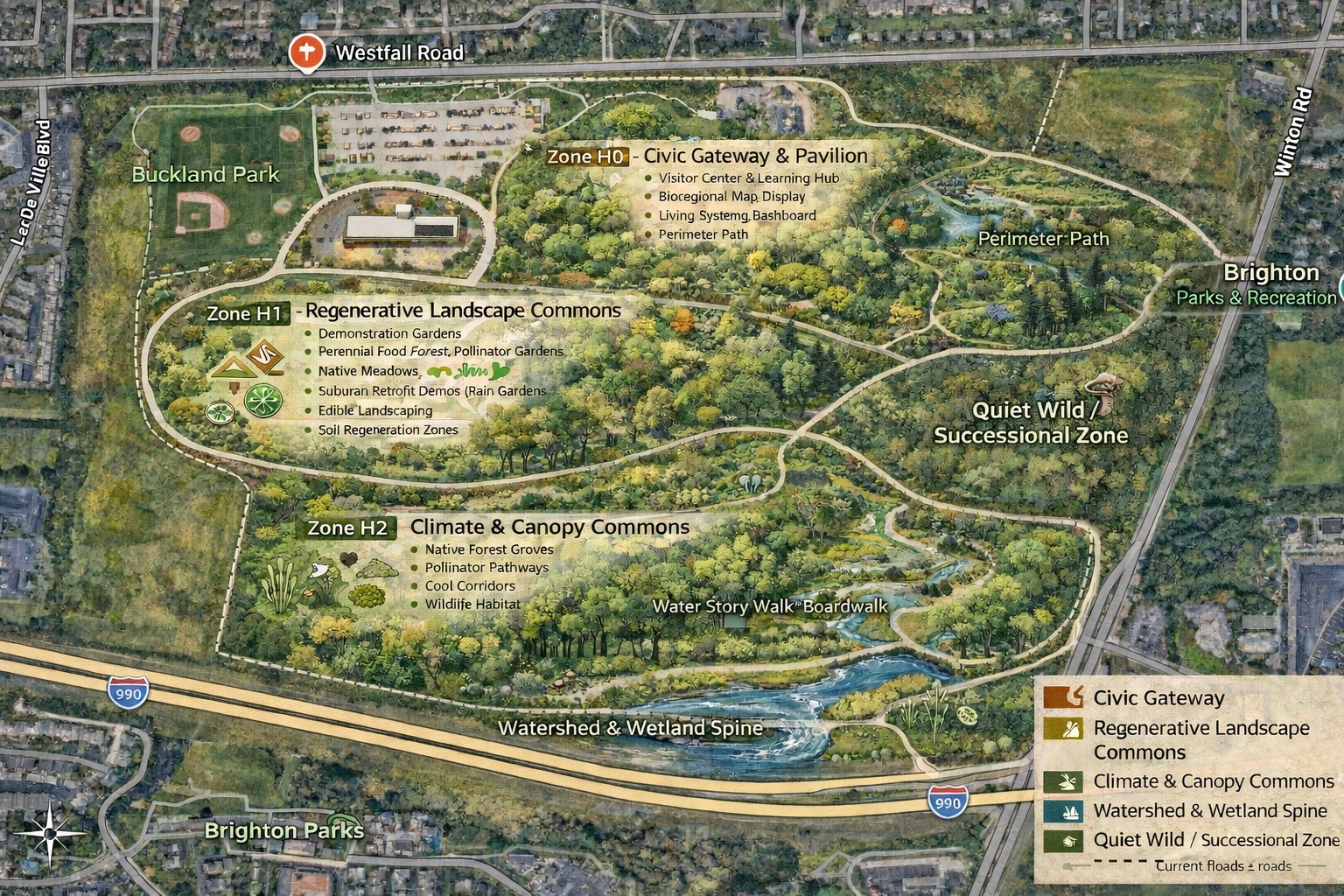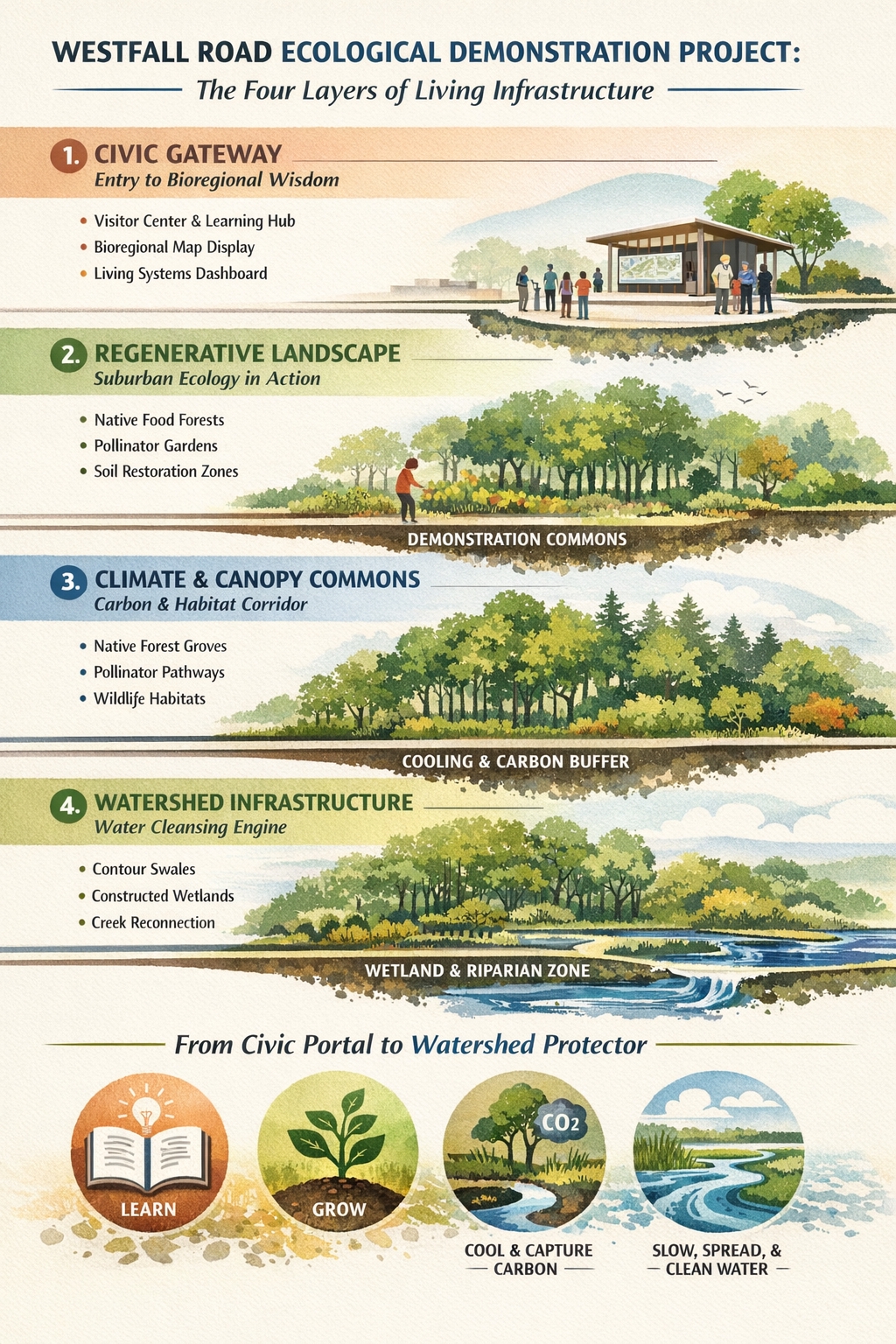
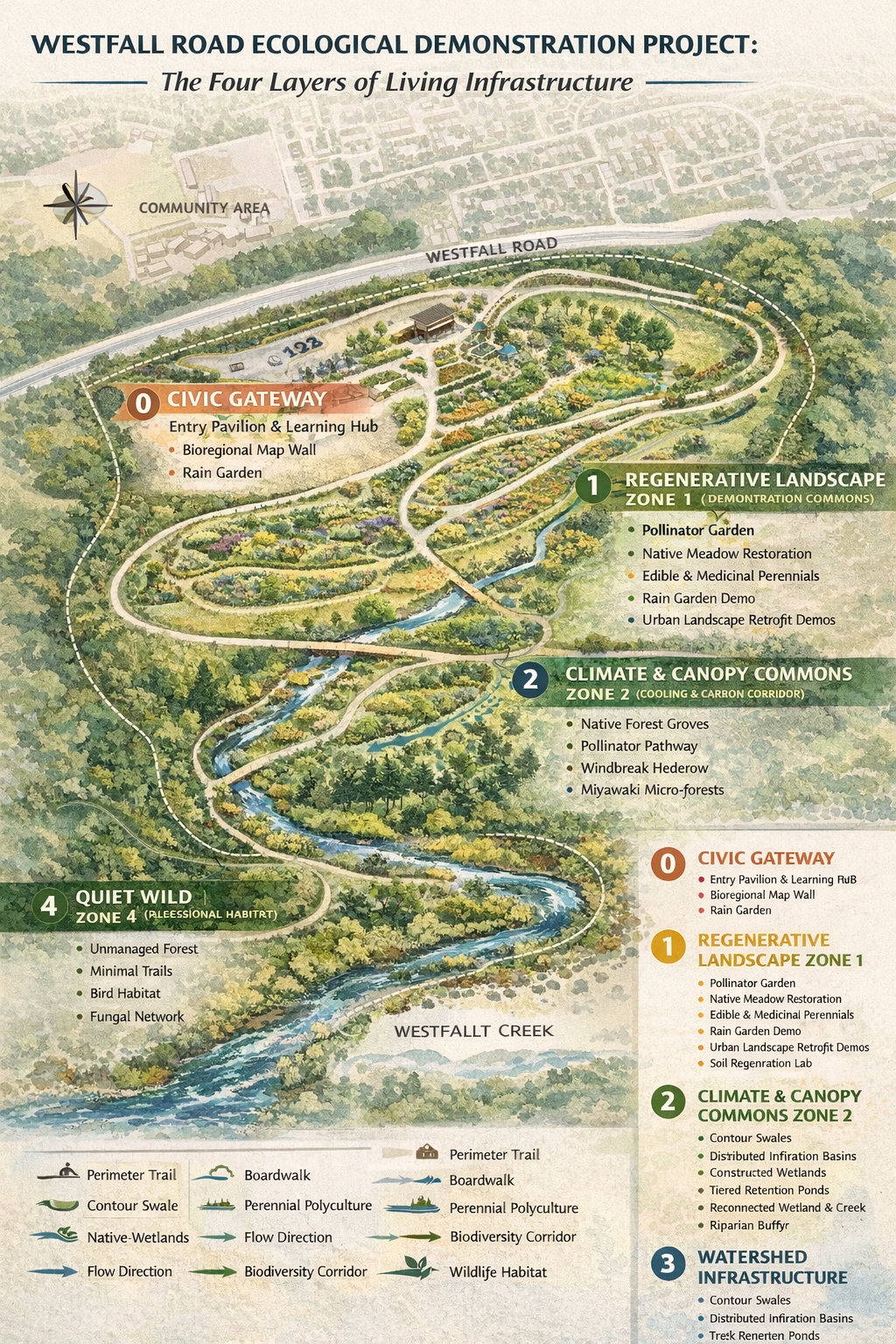
Here is a site masterplan–level permaculture zoning map tailored explicitly to the Westfall Road proposal. The design is grounded in the programmatic structure of the concept document (watershed spine, canopy commons, regenerative landscape, access network), but translated it into a permaculture spatial logic.
It is presented in three layers:
- Conceptual zoning map (what goes where and why)
- Functional systems diagram (how flows connect)
- A professional “planning-ready” version you can use with landscape architects or funders
I. Permaculture Zoning Masterplan
Westfall Road Ecological Demonstration Project (27 acres)
A. Primary Spatial Logic: “Hydrology First”
The site is organized along a north–south watershed spine, with human activity pushed to edges and ridges.
This directly implements your core principle:
“Design the land to do real work first — and invite people in second.” (Genesee Finger Lakes Bioregion)
B. Zoning Map (Textual Diagram)
[ ROAD / URBAN EDGE ]
        |
        |  Zone H0 — Civic Gateway & Pavilion
        |
----------------------------------------------------
|                                                  |
|  Zone H1 — Regenerative Landscape Commons        |
|  (meadows, food forests, soil labs, demos)       |
|                                                  |
----------------------------------------------------
|                                                  |
|  Zone H2 — Climate & Canopy Commons              |
|  (native forest, pollinator corridors, buffers)  |
|                                                  |
----------------------------------------------------
|                                                  |
|  Zone H3 — Watershed & Wetland Spine             |
|  (swales, wetlands, floodplain, riparian zone)   |
|                                                  |
----------------------------------------------------
|                                                  |
|  Zone H4 — Quiet Wild / Successional Habitat     |
|  (minimal access, ecological integrity)          |
|                                                  |
----------------------------------------------------
        |
        v
[ IRONDEQUOIT CREEK WATERSHED ]
This corresponds closely to your four programmatic zones but adds a fifth “quiet wild” layer that strengthens ecological credibility.
II. Detailed Zone Design
Zone H0 — Civic Gateway & Bioregional Interface (0.5–1 acre)
Purpose:
Narrative + legitimacy + learning.
Elements:
- Entry plaza
- Bioregional map wall
- Outdoor classroom pavilion
- “Living systems dashboard” (water, soil, biodiversity metrics)
Permaculture logic:
This is the “Zone 0” of a municipal ecosystem—the point of relationship between people and land.
Strategic value:
Makes invisible systems visible, fulfilling your stated goal to make ecological processes “functional and teachable.” (Genesee Finger Lakes Bioregion)
Zone H1 — Regenerative Landscape Demonstration Commons (4–5 acres)
This maps directly to your “Regenerative Landscape Demonstration Zone.” (Genesee Finger Lakes Bioregion)
Spatial sub-zones:
- Native meadow restoration plots
- Perennial food & medicinal guilds
- Suburban retrofit prototypes
- Soil regeneration laboratory
Example spatial layout:
[ Meadow Mosaic ]
[ Food Forest Cluster ]
[ Rain Garden + Swale Demo ]
[ Soil Carbon Plots ]
Core functions:
- education
- biodiversity
- suburban replication
- soil building
This zone is deliberately accessible and legible.
Zone H2 — Climate & Canopy Commons (6–8 acres)
Matches your canopy program. (Genesee Finger Lakes Bioregion)
Design structure:
- Forest patches (Miyawaki clusters)
- Pollinator corridors connecting patches
- Windbreak bands
- Microclimate nodes
Spatial pattern:
Forest Patch — Meadow Corridor — Forest Patch
        |                |
   Shrub Edge        Pollinator Spine
Key outputs:
- carbon sequestration
- heat mitigation
- habitat connectivity
- suburban reforestation model
This is the ecological “lungs” of the site.
Zone H3 — Watershed & Wetland Spine (8–10 acres)
Directly derived from your watershed framework. (Genesee Finger Lakes Bioregion)
Structural elements:
- contour swales
- retention basins
- tiered wetlands
- riparian buffers
- floodplain reconnection zones
Hydrological flow model:
Upland Runoff
   ↓
Swales → Infiltration Basins
   ↓
Constructed Wetlands
   ↓
Riparian Corridor
   ↓
Irondequoit Creek System
Strategic innovation:
Instrument this zone with sensors so Brighton can claim:
“This land is actively protecting our watershed.” (Genesee Finger Lakes Bioregion)
This makes the site measurable infrastructure, not symbolic landscaping.
Zone H4 — Quiet Wild / Successional Habitat (5–7 acres)
Not explicitly named in your proposal but implied by your ecological intent.
Characteristics:
- minimal trails
- unmanaged succession
- bird and pollinator refugia
- fungal networks
Why this matters:
Without a “non-demonstration” zone, the site risks becoming performative rather than ecological.
In permaculture terms:
This is your municipal Zone 5.
III. Cross-Zone System Overlay (The Real Design)
The power of this site comes from overlapping systems, not isolated zones.
1) Water System Overlay
- swales cross Zones H1–H3
- wetlands anchor H3
- rain gardens connect H1 to H3
2) Biodiversity Corridors
- pollinator corridors connect H1–H2–H4
- riparian corridor connects H3–H4
3) Human Access Network
Matches your “Human Access, Learning & Reflection Network.” (Genesee Finger Lakes Bioregion)
Design principle:
Humans move along edges, not cores.
Perimeter Trail Loop
      |
      +— Boardwalk (Wetlands)
      |
      +— Forest Path (Canopy Zone)
      |
      +— Meadow Loop (Demo Zone)
This minimizes ecological disturbance while maximizing learning.
IV. Professional Planning Diagram (What You Can Use Publicly)
If you were presenting this to Brighton, I would frame it as:
“Westfall Road as a Four-Layer Bioregional Infrastructure System”
- Hydrological Infrastructure
- Ecological Infrastructure
- Educational Infrastructure
- Civic Infrastructure
This aligns perfectly with your statement:
“Think ‘living infrastructure,’ not ‘amenity.’” (Genesee Finger Lakes Bioregion)
V. If You Want, I Can Now Create:
I recommend the next step be one of these (high impact):
A. A visual site masterplan map
- color-coded zones
- arrows showing flows
- legend suitable for a proposal or presentation
B. A Genesee Finger Lakes–specific plant palette
- native guilds
- wetland species
- canopy species
- suburban-adapted perennials
C. A “signature diagram”
The kind that makes funders and planners instantly grasp the concept.
If you want, I can produce A next: a clean, professional, permaculture zoning map that you could drop directly into the Westfall Road proposal or a grant application.
Given your broader Possible Planet / Bioregional Intelligence agenda, I can also design it so the map doubles as a bioregional intelligence visualization, not just a landscape plan.
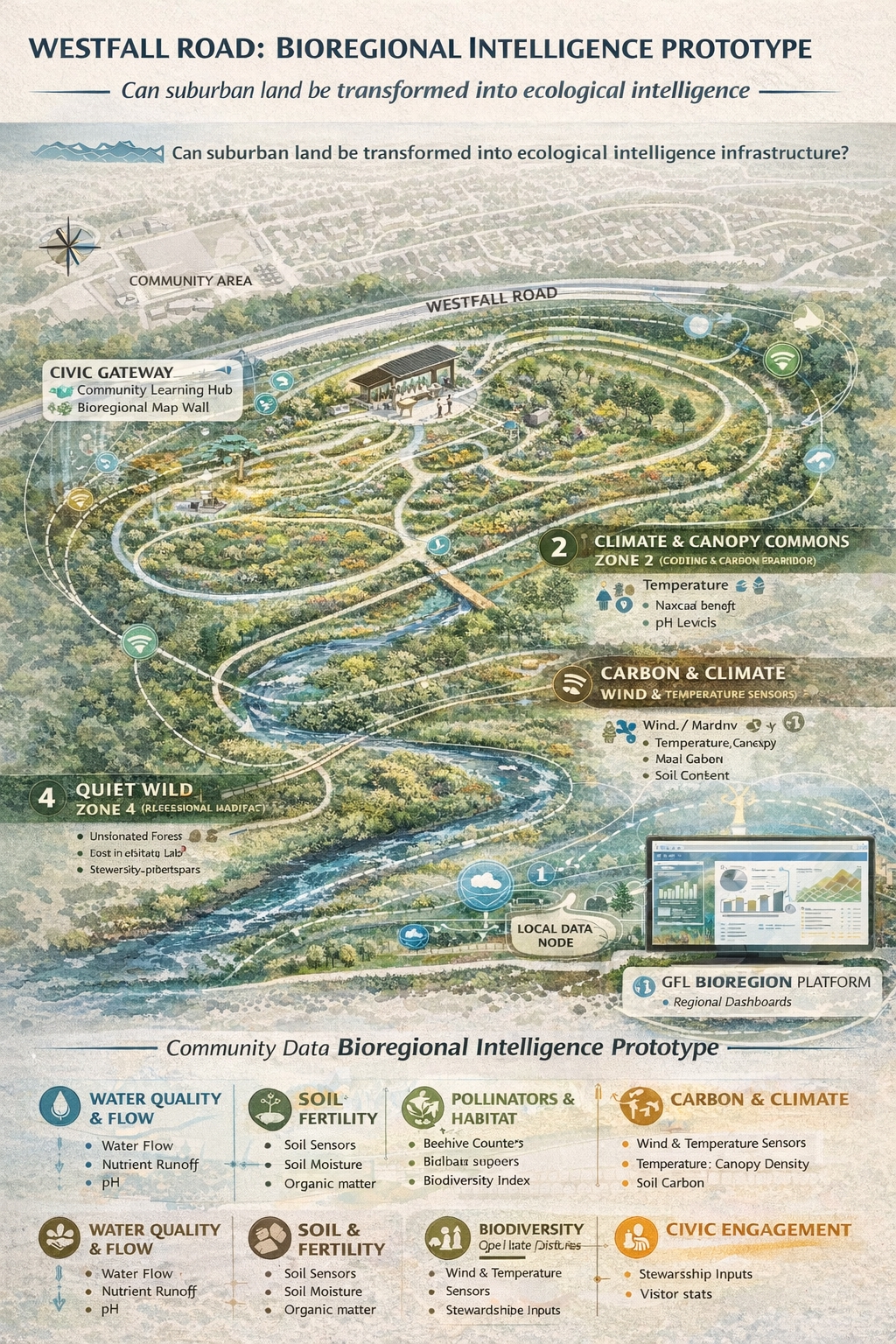
Below is a rigorous explanation you can use in proposals, presentations, or the Westfall Road document itself. I’ve written it at a conceptual + strategic level, not just descriptive, so it clearly positions the map as part of your broader Bioregional Intelligence framework.
How the Westfall Road Masterplan Map Functions as a Bioregional Intelligence Visualization
Most landscape plans show where things go.
This map shows how a bioregion works.
It is not merely a site design; it is a systems map that makes ecological, social, and climatic processes visible, legible, and measurable at a bioregional scale.
1) From Spatial Zones to System Intelligence
Each zone on the map is simultaneously:
- a physical landscape zone
- a functional ecological system
- a data-generating node
- a learning interface
Example:
| Landscape Element | Physical Function | Bioregional Intelligence Function |
|---|---|---|
| Wetland Spine | filters runoff | measures watershed health |
| Forest Canopy | cools microclimate | tracks carbon & heat mitigation |
| Meadows & Guilds | supports biodiversity | monitors pollinator networks |
| Civic Gateway | education hub | translates data into public meaning |
Thus, the map is a distributed sensing and meaning-making system, not just a design.
2) Visualization of Flows, Not Objects
Traditional site plans emphasize objects:
- trees
- paths
- buildings
- gardens
This map emphasizes flows:
Hydrological flows
- runoff → infiltration → wetlands → creek
- visible via arrows, contours, and swales
Ecological flows
- habitat corridors
- pollinator pathways
- successional gradients
Human flows
- learning paths
- stewardship zones
- access gradients
Climate flows
- cooling corridors
- carbon sinks
- windbreak patterns
In other words:
The map visualizes relationships, not just features.
That is the core of bioregional intelligence.
3) Nested Scales: Site → Suburb → Watershed → Bioregion
The map is designed to be readable at multiple scales.
A. Site scale
“What happens on these 27 acres?”
B. Suburban scale
“What could every neighborhood parcel do?”
C. Watershed scale
“How does this site affect Irondequoit Creek and Lake Ontario?”
D. Bioregional scale
“How does suburban land contribute to the Genesee Finger Lakes bioregion’s health?”
This nesting is intentional.
It transforms the site into a microcosm of the bioregion.
4) The Map as a Dashboard, Not a Diagram
The map implicitly encodes indicators that could be measured over time:
Water indicators
- infiltration rates
- nutrient retention
- flood buffering capacity
Soil indicators
- soil organic carbon
- microbial diversity
- erosion reduction
Biodiversity indicators
- pollinator abundance
- bird species richness
- native plant cover
Climate indicators
- surface temperature reduction
- canopy cover percentage
- carbon sequestration
Social indicators
- visitors
- stewardship participation
- educational programs
The landscape becomes a living dataset.
This is exactly what you have been articulating in the GFL Bioregional Intelligence vision.
5) The Map as a Translation Layer
Bioregional intelligence is useless if it cannot be understood.
The map functions as a translation interface between:
- scientists and citizens
- planners and residents
- data and meaning
- ecology and governance
For example:
- A swale is not just a ditch → it is “watershed resilience”
- A forest patch is not just trees → it is “climate infrastructure”
- A meadow is not just flowers → it is “biodiversity capital”
The map makes these translations visually intuitive.
6) The Map as a Replicable Template
A critical feature of the map is that it is not unique.
It is designed as a pattern language that could be applied across the bioregion:
- suburban parcels
- school grounds
- municipal lands
- corporate campuses
- church properties
- brownfields
Thus, the map is not just:
“Here is Westfall Road.”
It is:
“Here is a model for regenerating the Genesee Finger Lakes bioregion.”
7) The Conceptual Shift: From Park to Intelligence Infrastructure
The deepest innovation is this:
Traditional parks = recreational amenities
Westfall Road = bioregional intelligence infrastructure
The map visually encodes this shift.
It shows that:
- land can think (through feedback loops)
- landscapes can learn (through monitoring and adaptation)
- communities can see themselves as ecological actors
This directly aligns with your Possible Planet / Planetary Intelligence thesis.
8) Language You Can Use Publicly (Polished)
If helpful, here is a paragraph you can drop directly into the proposal:
The Westfall Road masterplan is intentionally designed not only as a landscape plan but as a bioregional intelligence visualization. Each zone represents both a physical intervention and a functional ecological system, making visible the flows of water, carbon, biodiversity, and human stewardship that shape the Genesee Finger Lakes bioregion. In this sense, the site functions as a living dashboard: a place where ecological processes can be observed, measured, and understood by residents, planners, and policymakers. Rather than a static park, Westfall Road becomes a prototype for how suburban land can operate as ecological infrastructure and a node in a larger bioregional intelligence network.
If you want, I can also produce a more visionary version, a more technical version, or a municipal/planning versionof this text.
9) If You Want, I Can Go One Level Deeper
The next step—if you want to make this truly distinctive—is to overlay the map with an explicit Bioregional Intelligence Layer, for example:
- icons showing data streams
- feedback loops
- governance nodes
- community participation points
- AI / dashboard integration
- connections to GFLBioregion.org
That would produce something close to a “bioregional operating system diagram”, not just a landscape map.
If you want, I can design that layer for Westfall Road.
Frankly, it would make this project intellectually and strategically unique in North America.
Taking this permaculture design and overlaying it on a Google map of the property…